Monday, August 19

Growth

Well, we are still a little less than a month from the Marathon Classic and I am very pleased with our recovery thus far.  Much of the seed we planted has germinated and begun to fill in nicely, and the existing bentgrass is filling many of the patches in on it's own.  More fertilizer and helpful chemicals are being applied today which will really help to keep things growing.

Look at the neat rows of emerging bentgrass seedlings filling in the spectator crosswalk on #10 fairway.

Another traffic patch on #9 fairway with lots of nice seedlings coming up.

 As this growth progresses in the fairways, we are going to begin repairing some of the areas in the rough that were damaged during the tournament as well as some of the bird baths from the monsoon season just before.  We will start around #2 green, #1 green, and #18 green where traffic and disease demolished some of our heavy bentgrass and poa annua rough.

Again, thank you for your patience while we get things put back together.


Friday, August 9

Progress

With Mother Nature cooperating, we were able to make a little headway on getting the course back in shape.  Liquid fertilizer applications to the fairways have initiated a nice growth and color response from the fairways, and the sod placed over the last week or two is knitting in nicely.

Also, we have scarified and seeded several of the areas thinned by the absence of Poa annua.  While I would love to have enough staff and sod to cover all of the damaged areas, it is economically and realistically necessary to try some seed in some of the areas.  This week #1, #10, #9, and most of the front nine were verticut, seeded and watered in hopes of getting some bentgrass re-established in the voids left by the deceased Poa annua.

First, we went through the areas with these verticutters to remove some of the dead "mat" to help with seed-soil contact.
The verticutters leave a nice set of grooves that we hope to get some seed into.

Using a drop spreader, bentgrass seed is spread over the surface

 We will continue to seed and sod over the next couple of weeks.  Mid-late August is the "sweet spot" for getting new seed and sod to set before the Poa annua in our soil starts to germinate.  Our goal is to get as much of the damaged areas to come back as bentgrass as soon as possible.  The more bent we get the less Poa will have a chance to re-invade.

There are things you can do to help us to maximize our success.  First, please try to avoid driving or even walking on any areas marked under repair.  Most of these areas have seed in them and the less we can disturb them the better.  Also, please be patient with us while we water.  In order to have any success, we will be running sprinklers during the day to keep seed and sod wet.  We will use hoses whenever feasible, but with so many areas to maintain, the sprinklers will give us better success.

Again, I thank you for your patience.  With a little luck, we should have things back to the great fairways you expect in a few weeks.

Sprinklers will be running during the day  for very brief periods to keep the seed wet.  

Stay out of the GUR as best you can.  It will help us with recovery.


Wednesday, July 31

The road to recovery

Despite all the activities going on in the grounds department these days, I would like to start with an excuse.  I haven't blogged since tournament week as I've been a little distracted by the birth of my first child.  On Wednesday, July 24th at 6:30 pm my wife Catlynn gave birth to an 8 lb 1 oz little girl named Lyla Symmes Salois.  Mom and baby are both doing great and I am extremely thrilled to start a new chapter in my life.
1 Day old Lyla
Touchdown!!


On a less happy note, I would like to copy and paste a preview of the August newsletter to the members.  I have written about dead grass for the last several weeks and I think this will be the last of it.  We have begun to travel down the road to recovery and that's what we will talk about for the next few months.  Mother Nature seems to be cooperating with the unseasonably cool and pleasant August, so it's onward and upward from here.  Quite frankly I'm sick to my stomach about course conditions right now, but there's no sense crying over spilled milk at this point.  All we can do is move forward and make the best out of it.  Below is my analog newsletter preview for August.

August 2013 Highlander

With the Marathon Classic behind us, the course you got back after the tournament is not the same course you had before.  Our mild summer turned severe at just the right time to do some significant damage to our fairways.  Low areas, poorly drained areas, and high cart traffic areas with high amounts of Poa annua have suffered.

As you all know, we had 18 days of rain and saturation leading up to the Marathon Classic.  The course was very wet, and standing water remained in some areas for weeks despite our best efforts to remove it.  There are four main components that combined to create the damage you see.

1.      1.  Mower and Cart Damage – Weeks of rain prevented us from mowing some areas for extended periods.  While the course was still a little wet, we were forced to throw our large fairway mowers back out to get the fairways back down to their proper height.  Also, while the course was still quite wet, we allowed carts.  When wet and soft areas are driven on or mowed, the stress on the plant is magnified.  Root systems are compacted, shifted, and the short-rooted Poa annua plant is weakened.  Once the weather turned from cold and wet to hot and humid, the weakest plants began to simply melt away.

2.      2.  Fungal Pressure – As always, the hot and humid conditions turned the wet golf course into a large “petri dish” that fungus loves to grow on.  Every year, we spray a multitude of chemicals to prevent fungal disease, but when conditions are so perfect for development, even the best chemicals will only control a percentage of the total infection.  Also, when plants are already weakened by mechanical damage and heat, the plants become exponentially more susceptible to infection.  Most of the lost turf is not directly related to fungal disease, but it is a large contributor to an overall weakened stand of turf.

3.      3.  Water damage – Low areas of the property and the odd “duck ponds” were underwater for weeks.  While we did squeegee off water whenever possible, the turf in these areas just suffocated and rotted. Many of you commented in the days leading up to the tournament how the smell of rot pervaded the property.  If it was near death after the rain stopped, the heat pushed it over the edge.

4.      4.  Poa annua – Our fairways are 50%+ Poa annua.  As I’ve discussed on many occasions, Poa creates a lovely surface, but is a much weaker plant than bentgrass.  Poa is short rooted, more susceptible to disease, and much more prone to “checking out” in hot, humid conditions. 

If there is any upside to the poor fairway conditions, most of the turf lost is Poa annua and not the more desirable bentgrass.  We have been using chemicals in the spring and fall to help the bentgrass “outcompete” the Poa and slowly transition to a higher percentage of bentgrass in the fairways.  Mother Nature has decided to accelerate that process for us.  In the short-term, the normally carpet-like conditions in the fairways is compromised, but in the long-term, it will help us towards our goal of a more vigorous stand of bentgrass and less Poa annua in our fairways.  Many members like to ask me why Inverness is re-grassing the golf course, and our situation is a perfect example why.

The plan for recovery is simple.  Patience, fertilizer, seed, aerification and sod.  We will exhaust our nursery to sod as many completely dead areas as possible.  The small patches that still have bentgrass living in or around them will be given extra fertilizer and water to encourage growth.  Areas that are mostly just “thinned” will be scarified and seeded with bentgrass.  We want to encourage as much bentgrass growth as possible before the fall comes and the Poa annua will germinate naturally from our soil seed bank.  To help things along, we will begin deep-tine aerifying our fairways in August to get some much needed oxygen into the soil and relieve the extra compaction from all the traffic and wetness.


Overall, this really was a “perfect storm”.  All of the above pressures combined into one week of really bad growing conditions.  With a little time and a lot of effort, we will come out better and stronger for the future.  I thank you for your patience.

Tuesday, July 16

Why you never get comfortable in this line of work

As the Marathon Classic enters the second day of its temporary colonization of our golf course, the heat is ON!  90+ degrees and extreme humidity have taken its toll on the golf course.  As I've said many times before, I would rather have no rain than too much rain.  Unfortunately, we have the perfect example of "why" right in front of us now.  Sadly, you will not be returning to quite the same conditions you had when you left.

Just this past Thursday, you will remember the golf course as completely saturated for right on two weeks straight.  Rain on 18 of 19 days prior, the golf course was in rough shape.  Standing water covered the fairways, rough, and even some tees for days.  We had not mowed fairways or tees for what seemed like forever.  Finally, with things letting up, we were beginning to mow again Friday, Saturday, and the heat and humidity set in.

Unfortunately for us, having as much Poa annua in our fairways as we do, this meant trouble.  Saturated, smelly soil practically suffocated turf in low areas and it only took a day of heat for things to start turning bad.  Turf in these areas is thin at least and in many cases gone.  Areas of high cart traffic seemed to take things the worst.  The start of 3 fairway, 7 fairway, 9 fairway and just about anywhere carts usually travel are loaded with Poa annua and really subject to loss.  The worst areas have been in poorly drained rough areas.

This picture is from last week.  As you can see the days and days of saturation was already beginning to take its toll on the turf.

Carts driving through these areas doesn't much help either.  This turf had already been thinned and stressed from carts.


Down in front of 1 green was lost long before tournament week.  Our best efforts to squeegee water off were for naught.

The usual puddles in #8 fairway were there for days, suffocating the turf.

Another area last week beginning to thin and stress out from being innundated.

Finally, we were able to mow Friday.  As you can see, we were actually bailing hay.


Now, more of these areas have begun to "check out" and more or less rot.

Compounding this damage was the fact that the saturation was so profound here that we could not make an effective chemical application to stem disease from harming us farther.  There were some areas of disease present.  Unfortunately, the damage from the water itself was far more prevalant.  As one of my friends put it, just plain ol' "jungle rot".

Now there is some hope for these areas.  They may not be quite as bad as they seem for the long term.  Since we have been able to make a chemical application, it seems there is some growth in many of these areas.  While they are browned out, with a few weeks of favorable conditions these areas can recover.  We will use nursery sod to repair the worst of the areas, but mostly rely on the plants to battle back and refill on their own.

This area has bentgrass remaining and will fill in over time.


Many areas of poor drainage have small blemishes such as this that will recover.  Probably a little disease here but should recover in short order.
In short, Mother Nature rained down on us and punished our weakest areas.  This isn't the first time, and won't be the last.  We will take what we learn from this and try to make things better in the future.

Wednesday, July 3

Hope in one hand....

While the golf course was inundated with rain water, we were in the process of completing another round of testing on our new well.  Unfortunately, the results are not what we were hoping for.  While every inch of the golf course was covered with water we didn't want, the water we did want directly beneath the surface was nowhere to be found.

The final results show that the well can sustain around 180 gallons per minute.  Our goal was 350-500 in order to prove sufficient groundwater to directly supply our sprinkler system without the use of a retention pond.  180 gallons would be sufficient to fill a pond (albeit slowly) but as we all know, the undertaking of pond construction is a much more complicated discussion.

There are two things to consider that keep my glass half-full.  First, the results do help us learn more about what our water supply is.  While the least expensive "option A" (digging two wells and directly supplying our lines) may be sliding off the table, we now have a better sense of what direction we need to take.  The goal of the well was to test our aquifer and see what we had.  The "hope" of the well was we had enough water to just hook it into our pipes and get on with life and go build bunkers.  Our hopes are somewhat dashed, but we now know which direction to head and we can set new goals.  Myself, the long-range planning committee, and the board are determined to make a path forward to correct our water issue.

The second thing that keeps my glass half-full is that the drawing board still has some ideas left on it.  There are some technologies available and some other options that may help us find the amount of water we need.  We will continue working to exhaust every option to find the water we want at a reasonable cost.  I haven't given up hope just yet for the "no pond" option.  Stay tuned.  I hope to know more in the next week or two.

If the water just isn't under our feet and the "no pond" option doesn't pan out, at least we will know for sure that the only real correction of our water issue will be a retention pond.  This is not a bad thing in terms of the function of the course, but it will be more costly and require a great deal more planning both logistically and financially.  Until we fix it, I will always believe that the best thing we can do to secure the future of this club (and my ability to maintain it) is get a new, clean, plentiful water source.  

Have a great 4th of July.

Friday, June 28

Water - can't live with it, can't live without it...

The lesson of the day is "be careful what you wish for."  Last year we couldn't buy a drop of rain, and this year it's getting crammed down our throat.  We are in the top 5 all-time wettest Junes.

As we enter our 4th straight day having a saturated golf course, the frustration is setting in.  I can sense it in the members, the golf shop, and certainly myself and my staff.  Carts can't get out, things can't get mowed, the greens are soft, the range tee is closed, and one of our best revenue streams (carts/guests) is severely limited, and people just get grumpy.   There's just not much to be done when it gets like this, and the golf course conditions suffer.


Please bear with us as we do our best to get things in some sort of shape.  We have been using squeegees and pumps to get as much water off as possible.  Today, we will begin using push mowers around greens and lightweight trim mowers to try and tackle as much of the rough as possible.  During times like this, it's the best we can do.

On the bright side, the steady rains have been in lighter, more frequent shots.  Unlike year's past, we have not had the big 2-4 inch dumps that take the creek clean out of the banks and shut the course down completely.  It's been a half- to one-inch chunks which at least keeps the major flood damage away (by the way I hope you all are "knocking on wood" at this point to avoid the catastrophic "jinx" I just likely initiated).

Above all, thanks for your patience and understanding as we attempt to battle what mother nature keeps hurling at us.


Friday, June 14

Now we are getting somewhere

I'm in a much better mood today.  The well drillers have hit 300 feet and their gut feeling is we have in the neighborhood of 400-450 gallons per minute capacity.  This means that we can dig a second well and have the necessary capacity to properly water the golf course WITHOUT the costly and disruptive construction of a retention pond.

This is great news, but it's not time to jump up and down and "a git to hollerin'" just yet.  The estimate of yield is based solely on the drillers 30+ years experience and the amount of water burping up during the drilling process.  The rubber will meet the road when they return to hook a pump up to the well and test capacity.  .  Also, this will give them important clues as to the nature of the aquifer and how far laterally the well is drawing water.  This is important to us as it will tell us how far away well #2 will have to be from well #1 to avoid overworking the supply while watering the golf course.

Overall, if this plan works, the plan to correct this golf course's greatest flaw will be much more simple.  We dig another well, get some new pumps (that I must continually remind you we will need anyways REGARDLESS of where we choose to get our water in the near future) and a new pump station (which we will also need anyways) and hook 'em up to the golf course.  No more dam in the creek holding back flood water (and no more downstream neighbors bitching about it), no more bulldozers in the creek, no more worrying about the quarry sending us enough water, no more pipes and sprinklers full of "creek turds", no more nightly shut-downs from debris, no more worrying about the army corps of engineers taking out our dam, no more excuses not to spend every dime we can on new bunkers, and a much more reliable source of clean, cool water for the golf course for decades to come.

Not to mention I will sleep much better in the summer.

Tuesday, June 11

Eureka there be water!

Well, the much anticipated well drilling is ongoing at the moment.  Currently, we are down around 200 feet. When you all were asking me what depth they were anticipating for good yield, the answer was about 175.  Unfortunately, we aren't quite getting the flow we are looking for.  Fortunately for us, there were some savings early on that will allow us to keep drilling deeper at no additional cost.  We will go to around 275 to see if we can get the 350-500 gallons per minute we need to make wells (without a pond) an option for our future watering needs.

We should have a good idea if not later tonight tomorrow as we plunge further into the earth.  Cross your fingers and hope that we can get a good geyser going soon!

The video is just a shot of the drill working away as it has the past few days.  Now, however, the compressed air they pump in is bringing our water to the surface and not just spoils.  Have a look.


Thursday, June 6

Well to-do


I must first begin by apologizing for not posting in some time.  The course has been very busy with projects and just getting the condition up to par for the upcoming summer season and this weekend's invitational.  I have been spending a great deal of time far away from my desk.  As most of you can see, there has been a lot going on.

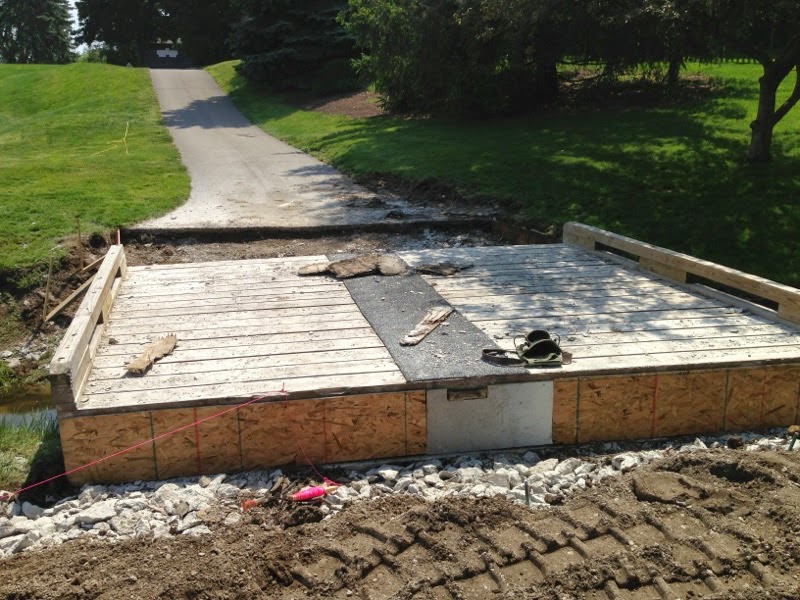
First of all, the new concrete work at the clubhouse is in, and the asphalt tie-in will be completed today.  We will follow suit by upgrading the plant materials in the entrance flower bed for a much more polished appearance as you enter the clubhouse.  While the concrete was being placed at the clubhouse, we decided to extend the cart path on #18 bridge.  This area was a constant eyesore between our member cart traffic and the tournament traffic and the concrete bridge approaches were uneven and difficult to drive on.  Overall a nice improvement that should last decades.
The old approaches were removed such that a smoother transition from path to bridge could be poured.

Workers pouring the new path leading up to the bridge
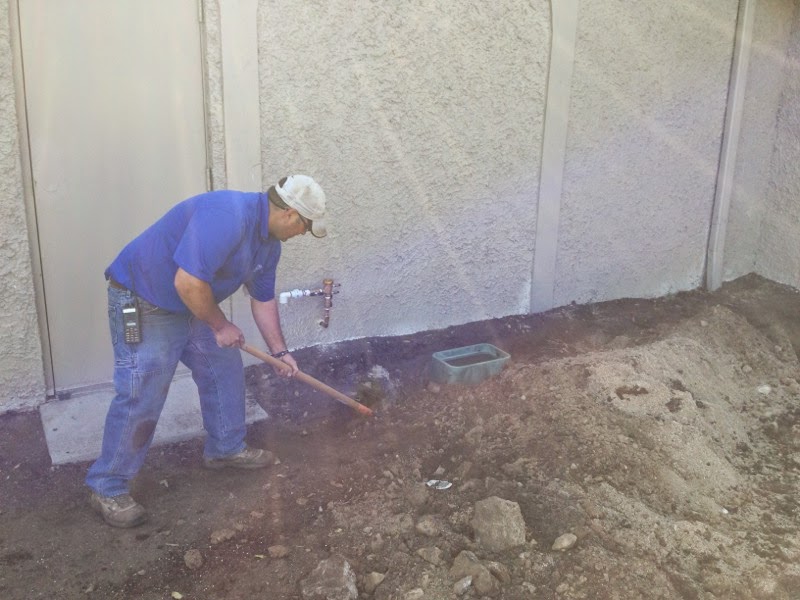
We are removing the old plants, most of which were in poor condition.  Also, we are installing sprinklers to help  the bed perform much better.  

The hollies in the entrance flower bed were different varieties and were in various states of death probably due to the winter time and perhaps some of last year's drought conditions.  They have been removed and new evergreens will be put in their place.

Aside from that the drilling of the well has finally begun!  Drillers are on-site and have commenced drilling the hole for the 10" pipe that will keep the soil portion of the hole from caving in.  I spoke with the driller today and solid bedrock was hit a mere 10 feet below the surface.  This means that due to regulations, our well pipe will have to be at least 30-35 feet deep to ensure there is no caving in and no contamination can enter the aquifer.

Once the pipe is set, they will then use a smaller bit to drill inside the pipe.  The wall of the bedrock will then act as our pipe from the bottom of the actual pipe to the bottom of the well.  Given recent well records in this area, we anticipate getting our best flow somewhere between 150-200 feet.  I hope to get no less than 400-500 gallons per minute.

Assuming everything goes well, the pipe should be set by tomorrow sometime, and we may start to see water as soon as Friday evening.  For sure, Monday will be likely to start seeing some more significant water.  Once we reach a depth that we suspect will provide the needed flow, the drillers will hook a large pump up and test the wells ability to provide water.  This will give us a very good idea of exactly what we've got to work with.

Finally, the first step towards securing good, clean, and (hopefully) plentiful water for the golf course has begun.

Drill Rig poised to mess things up

Here is the drill bit that will bore out the hole for our pipe.  Nasty!

Thursday, May 2

Can't Fight Mother Nature

This week, the PGA Tour is playing the Wells Fargo Championship at Quail Hollow Golf Club.  The news of the week has been the struggling greens.  A couple of their putting surfaces were deemed "unacceptable" for tournament play and re-sodded as little as 7 days ago!  As far as I know, a green being built seven days before a PGA event is to be played upon it is UNHEARD OF!  The rest of their greens have been described as "rough" at best and even likened to a "run-down municipal course".

First of all, the Superintendent and Grounds Department at that course is to be commended for their work in scrapping together the best conditions they can in a difficult situation.  Being an annual host of an LPGA event, I understand the pressure (often self-inflicted) that is on a superintendent to put forth perfect conditions for the pros.  According to the press I've read about this, Quail Hollow has long been considered one of the best maintained tracks out there and very highly regarded for normally fantastic putting surfaces.

The big question golfers will want to ask is simply "why?"  Smokey back rooms at private golf clubs around the country are probably full of crusty old farts making idiotic comments: "They are obviously a very nice club and probably have gobs of money and yadda yadda this is unacceptable yadda yadda fire the superintendent blah blah." As superintendents and golf industry people know, the answer in this case is quite simple: You can't fight mother nature.

Upon hearing about this story, I immediately started looking at industry related articles about it to get some facts.  The newspaper articles about it were piss-poor at best with confusing "facts" and misleading comments from club members and professional golfers. One journalist interviewed a former professional golfer that happened to be a member at Quail Hollow in which he blamed sand topdressing on the reason one of the greens died.  Just so you know, that is complete BS.  This course is managed by a professional superintendent under the advisement of the PGA tour agronomists and a very highly respected turf scientist from Clemson.  There's no way that happened.  I don't have all the facts, but 20 years in the business and a few industry articles I can piece most of it together.  Unfortunately, the real reason the greens suffered is all too common a problem at clubs like this and involves three key points:

1.  The greens are bentgrass.  North Carolina is a HORRIBLE place to grow bentgrass.  With the exception of some higher elevations that stay a little cooler, most of North Carolina can get very hot for very long stretches.  Bentgrasses are not adapted to suffer such long periods of high soil temperatures and after awhile they can just "check out".  Quail Hollow did everything they could to help the bentgrass survive - sub-air systems, I'm sure they had fans, and I'm sure they spared no expense to keep the stuff alive.  They have admittedly struggled the last few record hot summers so I'm sure they pulled out all the stops.

2.  The bentgrass variety was (reportedly) Penn G-2.  Over the last 10 years, G-2 has proven to be a real dud of a bentgrass variety.  It seems highly susceptible to bacterial wilt/decline issues and according to the turf scientist on the scene at QH, likes to segregate into different "populations" that react differently and inconsistently to maintenance practices.  As you all know, our neighbor Inverness Club is re-grassing their greens due to having "issues" with putting quality, speed, and bacterial decline.  They ALSO have Penn G-2 that is about 10 years old.  Hmmmmmm......

3.  I know what you're saying, it's SPRING!  Why is it dead now???  I suspect the decline occurred over the last few summers and they haven't had the weather to recover fully.  You all have been whining about the wet, cold spring we have had.  Grass only really started growing a few weeks ago.

So what you have here is a premier, wealthy club wanting the superior putting quality that bentgrass provides trying to force it to live and grow where it is not adapted.  On top of that, by sheer bad luck, they chose a poor variety to do it with.  Had they been able to look into the future, they could have chosen a different bentgrass and had better success, but likely would have struggled anyhow.  NO amount of money can override what a plant is capable of enduring.

From what I read, the club is doing the right thing.  Once the tournament is over, they are re-grassing with one of the newer greens quality bermudagrass varieties.  This has been the trend at more southern high-end clubs who were losing the bentgrass battle.  These bermudagrasses are adapted to hot climates and will thrive in the heat and should provide great putting surfaces with far less inputs, pesticides, and water than the bentgrass.

More importantly (to me at least), the superintendent will not be setup for failure.  Growing bentgrass in the Carolinas is more often than not a losing battle.  Having an appropriate species of turf will allow the grounds department to focus on making the greens great instead of just keeping it alive.  This will be good for the club, the staff, and the superintendent.

My overall point from the perspective of our club is this:  We are also growing a poorly adapted variety in an often harsh environment with our mostly Poa greens and fairways.  Most years we do fine, but when the weather takes a turn to the severe, things can get ugly as it did for us in 2010 and briefly in 2012.  We can't always provide tour quality conditions when we are spending so much energy just keeping it alive.  So please, when you are watching the Wells Fargo Championship this week, take it easy on Quail Hollow and especially my colleague there.  The club, NOT the superintendent, played with fire and got burned.

There's a link below to one of the articles that I grabbed this pic from.


PROAM_33
The Greens at Quail Hollow this week.

http://www.dallasnews.com/sports/golf/headlines/20130501-golfers-compare-usually-immaculate-quail-hollow-greens-to-a-rundown-municipal-course.ece

Tuesday, April 16

Screw-Up

I will never forget my first year as superintendent.  Feeling good about successfully getting through spring aerification, I went into the golf shop the very next day after we reopened the golf course.  A member standing in the golf shop ready to go out and play was expressing his frustration at length to his playing partner about how the greens were "all screwed up".  I couldn't help but chuckle a little.

So alas, we have "screwed up" the greens yet again.  Every year, I talk at length about why it's important for maintenance of a high-performing, high-traffic putting surface blah blah organic matter blah blah drainage blah blah.  Often when I am answering member's questions about aerification, the expression on their face is obviously a polite attempt to seem interested when their real train of thought is more akin to "I don't really give a crap, when will the greens stop sucking?"  As many of my followers know, there are lots of good reasons we do this each year, and I will point you to the blog archives if you want my early, more detailed discussions of the reasons we screw the greens up each year.  If you have specific questions, don't hesitate to email, call, or comment on the blog.

Overall, I am very pleased with how they came out.  Again, we did not pull out any "core" from the green but merely applied heavy sand and proceeded to pound it into the profile with solid tines.  This will allow for better putting conditions sooner and we get more sand into our profile this way, which really is the ultimate goal of the process.   The steady rain that has pounded the golf course all morning will really help even out the sand and get the fertilizer washed in.  With a little warmer weather, we should have a speedy recovery.

The topdresser applying a heavy sand layer.

Most of the sand is gone once we punch 3/4 inch holes

After punching, a power brush whisks the sand into the holes.  It takes about 5-times over the green to get all the holes filled.

Two types of fertilizer are applied to ensure a healthy and speedy recovery.

Tuesday, April 9

Tree Management - not just above ground

Below is a very concise article about tree management from the USGA as posted in the Green Section Record.  It covers not just what we do above ground when pruning, removing, or maintaining trees, but also looks at root pruning beneath the surface.  Last fall we rented a vibratory plow to do just that and we hope to see some fairly dramatic improvements in some areas affected by tree roots.  Several fairways, tees, and even some greens are negatively affected by the presence of tree roots and the below article explains quite well our efforts to minimize that impact.

http://gsr.lib.msu.edu/article/vavrek-getting-4-5-13.pdf

Tuesday, April 2

FINALLY - Opening day approaches and Aerification rescheduled

I have been getting peppered with questions and comments the last two weeks about the long winter we appear to be having.  I hate to break it to you all, but what we are experiencing is.....wait for it......NORMAL!  The idea that this winter has been hanging on abnormally long (by the way Punxatawny Phil is an idiot) is really just relative to the last 3-4 seasons.

My first 4 years here we never opened in March and usually it was a little dicey at that.  The last 4, however have been a different story.  Early spring rains, early warm-ups, and just general strange weather have had our first tee rocking as soon as St. Patricks Day.  While it may SEEM like things are dragging on, we are actually just "back to normal" so to speak.

That being said, the pins will be back in the greens Thursday afternoon.  We have finally had enough warm weather to put our first cuts on tees, fairways, and greens and get some much needed cleanup completed.  The 2013 season will finally begin!  Also, as a result aerification will move from the scheduled date of April 8th to April 15th to better accommodate some early season golf and get some better growing conditions so we can heal quickly.


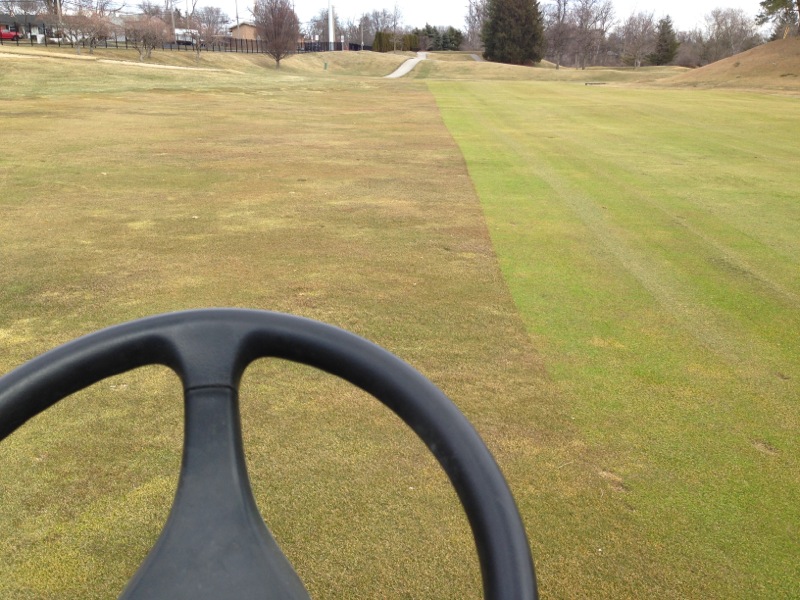
The operator (me) view of #18 getting the winter fuzz knocked off.

18 fairway finished.  Finally some green on the golf course.


In the meantime, we have brought a few key staff back from their winter hibernation to tackle some last-minute tree work and clearing projects long overdue.  We had the projects approved years ago but the last 4 seasons early openings have prevented us from getting them done.  Late winter/early spring can be a perfect time to do tree work due to the hard, frozen ground and safety to the tree.   The first major clearing was to remove the "woods" behind 14 green.  This area was just infested with poison ivy, brush, and old piles of leaves from autumn past.  Also, it's always wet and muddy around the area due to the lack of sun, turf, and air movement.  Most important, this area, along with a similar area adjacent to 13 ladies tee were inconsistent with the rest of the property.  "Afterthoughts" at best.

BEFORE

Also this leaner had to come down for safety and for the sake of the turf.

Thick piles of leaves and poison ivy are all that inhabit this area.  
AFTER clearing and "de-brushing" you can see the sunlight and by removing the brush we have "added" some nice trees (unfortunately they are mostly cottonwoods) that were hidden.  We will work to get the stumps and leaves out in order to eventually seed the area.
 Also we have taken a couple of trees down.  Last fall, after a course tour, the grounds committee decided to approve the removal of a couple of prominent trees.  The first would be the sweetgum tree that overhangs #17 green.  There is a clump of three that were planted years ago to hide 18 and the electric lines from view.  Unfortunately they planted the first within 15 feet of the green edge.   Also, as we know, the sweetgum drops somewhere between 1000 and 100,000 of those annoying spiny seed pods or "gum balls".  This may be the worst species of tree you can plant next to a green.  As you can see in the picture below, the tree had grown to overhang in spots.  It was time to go.  Plus, with the size of the other two sweetgums directly behind, we didn't lose any screening of the electrical lines.
Sweetgum limbs hanging over the green edge.


"Gum Balls" on the green and collar.


Remaining trees still hide the electric lines.

 The next tree we tackled was the "lightning oak" next to number 8 green.  It's health had declined over the last couple of years probably due to the lightning that struck it several years back.  Also, it is in a clump of several large trees right next to the green.  The size of these trees has made it more difficult to grow grass on #8 green.  It was time to go, and we plucked the weakest from the herd.

Distorted bark missing from the lightning strike.

With the other trees so close, it won't be missed.

So as of now, we are keeping busy.  After another week of tree work, the crew will be happy the course is open and we can get back to mowing.  Look forward to seeing you all on the course soon!

Tuesday, March 12

Tale of two seasons and getting high on the course.

Now that we've moved our clock ahead an hour (and hopefully changed the batteries in our smoke detectors) you can sense a noticeable "twitch" in our membership.  Opening day is certainly getting close, but relative to last year we could be looking at a much later opening date.

The reasons are fairly obvious to most.  Last year by this time we were warm (Upper 60's to near 80 degrees!), green, and the grass was growing quite nicely.  We had already mowed the greens, fairways, and tees once or twice and the turf was ready for play which allowed us to open shortly after St. Patty's Day 2012.  Subsequently, we proceeded to have the best March golf season I've seen since I got here 8 years ago.  Today, one only need step out of the back dining room doors to notice that the surfaces are still soft and the grass is still pretty much brown, dormant, and nowhere near ready to cut.

To put a bit of turf "nerdism" behind it, here are some numbers to help explain.  To help predict the growth of plants many superintendents, landscapers, horticulturists, and scientists use "growing degree days" or "heat units" which are "a measure of heat above a threshold for a day" or even simpler - how much time has the plant had in temperatures that are favorable for growth.  We use this data to predict flowering, growth, chemical applications, insect growth and other things.  So far, in terms of heat units we are 75% behind where we were last year.  Using the heat unit calculation, it would take 15 days of 60-degree highs and 40-degree lows to catch up to where we were last year at this time. As of right now, the forecast isn't anywhere near 60 daytime or above 40 at night in the next few days.

Some may have a tendency to gripe that the course is not open this past weekend with our first nice 50-60 degree temperatures.  Several public facilities were open with carts available.  While this make sense on their end for revenue, it does not for us.  Had we put a full Highland Meadows weekend day with carts on our soft, saturated course, it would likely have made ruts, tracks, mud holes and footprints from tee to green that would be slow to recover and offer substandard conditions for the remainder of the spring.  It is the mission of HMGC to offer outstanding, private club conditions all season long to differentiate ourselves from the daily fee golf courses.  A premature opening would put us behind from day one.

That being said, I fully understand your desires to get out there and enjoy your course as soon as possible.  Rest assured we are watching the conditions daily and will be prepared to pounce when the time is right.

Since we aren't growing and mowing like last year, we have been using our time to get some necessary pre-spring work completed.  This past week we took on the task of pruning our key oak trees.  TIP: It is important to prune oak trees prior to April 1st in our area in order to minimize exposure to Oak Wilt Disease (OWD).  OWD can wipe out an oak tree in short order.  Check out this article in the Toledo Blade to learn more:  Toledo Blade OWD Article Click Here

Some of the most important oak trees on the course are around 8 green and at the start of #16 fairway.  On 8 green the focus was to increase air movement and sunlight in this "over-treed" area and on 16 we wanted to improve the look of the trees as well as increase the window for the tee shot.  These two oaks have grown far into the line of play and made it quite difficult to craft a proper tee shot.  A large "cherry picker" bucket lift was brought in so we could reach the higher limbs.  Since the skeleton crew of two are afraid of heights, I got to be the one in the bucket while they cleaned below.  Don't tell them, but I had a blast and it gave me some unique perspective pictures of the course.  Also, it was just great to shake off a little "shop fever".


The view from the top looking toward the snowy 8 green.  

A lot of large limbs were brought down around number 8.  This will allow more air, sun AND golf balls to get to the green.

16 oak trees BEFORE we trimmed it as viewed from 16 tee.  We all know how difficult it is to get around this thing with a driver.
16 oaks from the tee AFTER we trimmed.  We brought it more out of play and opened up a  little more room to fit a tee shot.

Both the north and south oaks were trimmed to make a symmetrical silhouette.

Just a shot from about 40 feet above 8 green.


A look down 16 fairway at the chickens below.


A nice view of #5 green from above

 Overall a very productive day.  We will be bringing the bucket lift in again for some more pruning in the near future, but getting those crucial oak trees early was key.

Let's hope for some better temperatures soon so we can get out and play some golf!