Tuesday, January 15

What do we DO in the winter?

Happy New Year to everyone!  After a busy holiday break, the skeleton crew of a grounds staff is back at it.  Every year about this time I write a textbook piece on "what we do" in the winter.  Despite my best efforts to educate every member I talk to, this is STILL the number one question on anyone's mind this time of year (probably cuz they want to know why the hell they are paying grass growers to be on staff when the ground is frozen and buried under snow....can't say as I blame them.).  I absolutely despise repeating myself, but for the sake of any new follower's to my blog or new members to the club, I will again comment on our early winter activities in 2013.

As for the 3-man crew that remains, the objectives in the winter are as follows:

1.  Do EVERYTHING possible to make sure we minimize mid-season breakdowns.  This involves a surprising 'tear down and re-build' of just about every machine that we own.  Generally speaking, we will remove wear parts such as bearings, seals, bushings and switches and replace them as needed to ensure no issues in the heat of the summer.   Depending on the age of the equipment and how bad of a beating it takes, winter service ranges from simple tasks such as oil changes to more involved projects such as splitting tractors in half to repair transmissions.  Also, we will grind, true, and sharpen every single piece of metal that cuts grass.  Fortunately, here at Highland Meadows we have one of the best equipment managers in the area who can do just about anything in-house when it comes to turf equipment. He will guide the other 2 staff members through an in-depth preventative maintenance program that has paid very tangible dividends to our operation.  Since Arthur took over the equipment in 2005, we have experienced fewer breakdowns, better cutting unit performance, fewer hydraulic leaks and several very old pieces of equipment still manage to perform well despite being past their useful life.  This translates to more consistent conditions, less mowing during play, more efficient use of seasonal labor, more time between costly equipment replacement and obviously less dead grass from hydraulic oil or fuel leaks.  Also, during tear-down we can identify and repair problems as we see them in winter instead of having crucial equipment disabled during the golf season.  While not the most fun or exciting work, the winter equipment service saves a lot of headaches and money.

Rough-cutting units have a great deal of moving wear parts.  They are completely disassembled and re-built as needed each season to keep your ball playable in the rough.

You may be used to seeing the unit intact, so here we are tore down to the frame.  The cutting units are then tore down to just parts to inspect and repair anything required.


Fortunately, our experienced staff is capable of fabricating our own parts.  Here, Jason is making some brackets for the rough mower that otherwise would have been expensive and we would have had to pay shipping.

Gear boxes and pulleys removed for service.
A batch of walk-behind greens mowers with the engines removed in preparation for service and grinding.

Cowlings and engines are being removed to clean, grease, and re-seal all drive chains.  Once complete, it will be off to the grinders for a good sharpening.

2.  Re-finish all course accessories.  Once the equipment service is near completion, we will begin to address course accessories.  Tee markers, ball washers, hazard stakes, bunker rakes, benches, cooler houses, yellow rope stakes and just about anything else you see on the course that is man-made is removed from the course, sanded or sand blasted, and refinished.  It's bad enough we have to have all that stuff out there to clutter up the landscape, but it's worse if they all look ugly or in disrepair.

3.  Plow snow - as snow may fall this season, your maintenance staff handles the parking lot and maintenance road plowing.

4.  Shop/Facility improvements - Our facility is very out-dated, undersized, and just plain old.  Each winter we make a series of improvements or repairs to keep in functional and as safe as possible for each year.

5.  Project/Tree work - If the weather and budget allow, we may step out of the shop for a little project now and again.

6. Continuing Education - All of us that remain on staff are credentialed professionals in one way or another.  Maintaining our state pesticide licenses and professional accreditation is very important for our careers.  Also, with new developments in research, techniques, and technology we need to stay abreast of everything going on to best serve HMGC and the community.  We do this by attending education conferences and trade shows throughout the region.

7.  Planning - Reflecting on the previous season and finding ways to improve also takes up a lot of winter.  If we aren't improving, then you should probably fire us all.  The staffing, fertilizing, pesticide, and financial planning all happen this time of year for the upcoming season.

As you can see, we manage to stay pretty darn busy even with the snow on the ground.  Along with all of that, we are still working on digging a well to look for an alternative irrigation water source.  More on that soon.  STAY TUNED!!

Friday, December 21

Merry Christmas to All

Winter is finally here and despite the Mayan calendar, the world appears to be intact.  Since I probably won't have a blog post until after the new year, I just wanted to take time to thank you all for another great season.  Contributions to the employee end-of-year bonus program were full as usual and my staff received a nice little Christmas bonus.  On behalf of my employees, thanks to all that contributed.

We wish you all the best of times this holiday season, and look forward to seeing you all at the club in 2013. Merry Christmas!


Tuesday, December 11

Now I lay me down to sleep.......

With normal winter weather finally coming, it is time to put the greens to bed for the season.  In my eight years here, this is the longest golf season we have ever had.  Fully open and operational in mid March and closing on December 10 is unprecedented.  Having spoken with several members over the past few weeks, even the "die-hards" seem ready to mothball the sticks for a few months or head south for fairer weather.

There are several things we have done this season to help the greens fare well through the winter as well as hopefully come roaring up in the spring.  We started a week or so ago by applying our winter pesticides for control of snow mold followed by a "dormant feed" of simple fertilizer.  The chemicals will hopefully control any snow mold fungi present, but just in case we missed a spot, the fertilizer will make sure that the greens and tees will wake up quite quickly in the spring to "grow out" of any damage.

Finally, after the last few hardy golfers leave the grounds, we apply a moderate topdressing of sand.  The sand will act to protect the crown of the plant from any damage through the winter as well as provide a nice layer to smooth out any surface inconsistencies in the spring.

Don't tell anyone, but topdressing is also effective at keeping the winter golfers from putting on the greens in the offseason.
  Also, the temporary pins have been set in the fairways and approaches for winter play.  If the temperature and mood suit you this winter, feel free to walk the course and hit a few balls to our temporary pins.

As we do every year, winter preventative maintenance has already begun.  Golf carts and utility vehicles are being serviced as we speak, and an entire fleet of equipment awaits a tear-down and re-build.  This work is important to our smooth operation during the golf season and a welcome chance for the staff to get away from the normal grind of daily golf operations.  We use the winter wisely as a time to recharge our batteries for the upcoming busy season and most will use their time off during the Holidays to make up for lost time with family.

As the holidays approach and we move into the new year, occasionally check the grounds department blog.  As interesting things happen I will be sure to post them.  I spend a great deal of time in continuing education and industry related activities (and goose-chasing) during the off-season and always learn a few things worth repeating.  Also keep an eye peeled for staff profiles over the winter.  It will be a great chance to learn more about the employees that have served you for many years.

Thanks for another great season.  Good luck with the Christmas shopping, and we will see you around the club!


Friday, December 7

The Un-buddy system

Below is a link to this weeks USGA Green Section Record.  In the past, I have posted links to interesting articles and commentary from this site.  Lately, they haven't posted much content that would be of interest to anyone other than a turf nerd like me.

This installment, however, has some great articles with some take home messages for golfers too including an interesting look at single rider golf cart use.  Something I have noticed the last couple of seasons here at Highland is a definite increase in groups that have almost as many riding golf carts as players.  Keep in mind that each extra cart means things to the condition of the course.  Cart traffic creates compaction and general stress to the turf that results in some serious maintenance challenges.

Don't take my word for it, click below -
USGA Green Section Record Click Here!

Monday, October 29

Tree Cutting Season is upon us!

"As beautiful as trees are, and as fond as you and I are of them, we still must not lose sight of the fact that there is a limited place for them in golf. We must not allow our sentiments to crowd out the real intent of a golf course, that of providing fair playing conditions. If it in any way interferes with a properly played stroke, I think the tree is an unfair hazard and should not be allowed to stand."

- Donald Ross, from Golf Has Never Failed Me


About this time every year I am inspired to sit and write something to the members about tree management.  Most likely because I just removed several of them from the golf course and need to do what I can to defend....errr....explain why.  

Let me start out with one fact that you probably won't believe - I love trees.  There, I said it.  I bloody well love trees.  I am at heart a moderate environmentalist with roots in the Pacific Northwest which is arguably  the "tree-huggiest" of all the "tree-huggiest" places on earth.  You couldn't get me out of the woods as a kid.  Being a child of modest means, vacation was often spent in the trees camping or hiking or fishing or any other activity that involved shorts and wool socks.  This love of the outdoors was one of the major reasons I pursued a career in the green industry in the first place.   I see my job as much as an "environmental manager" as a golf course superintendent.  A "Steward" of the land, if you will.

Now that you realize I am a tofu-nibbling tree hugger, I want you all to know that I don't just drive about the course with my "paint can of death" marking trees for the slaughter to suit my mood that day.  There is a great deal of thought, discussion, and education as to the intent of each removal as well as discussions for possible replacement if deemed appropriate.  Just this past month I took the grounds committee out to each area I wished to remove some trees and made my case in person for each stem.  Once the committee understood my reasoning, they even started coming up with suggestions for further improvements down the road.  In the process, they unanimously approved the removals without hesitation.  A little education goes a long way.

Education is important becaus let's face it - people get very emotionally attached to trees.  They are impressive giants of the landscape that almost instantly bring a sense of nostalgia or imply some sort of inherent wisdom within.  This is a big reason most "city folk" join clubs like ours.  Unfortunately for you sensitive types, trees are just plants.  And just like plants in the landscape, there are some that need pruning, some that need attention, and some just need to be yanked out.   While trees can be beautiful and offer a great aesthetic or environmental benefit,  some are just hard weeds that got too big.

Today, we removed several "hard weeds" for the betterment of aesthetics, playing c0ndition, safety and a long-term improvement of our tree stand.  The top priority was to remove the large oak behind #5 green as seen below.   This is the "sister" tree to the one that fell and damaged the green over the summer.  With many of the trees having fallen around it over the years, this misshapen oak was "hung out to dry" by itself.  My biggest fear was that given the growth habit of the tree and the fact that it had almost no protection it would be prone to falling and damaging the green even worse than it's "sister".  Since it used to be part of a thick stand that has since fallen, mostly due to ash borer, the growth habit was all towards the green, putting almost all of the trees weight right where we don't want it.


Noticably "one sided" tree.  We could have pruned it to relieve the weight, but would have been left with an "upside down feather duster"

The branches hung straight towards the green.
After the oak on #5 was down, we focused our attention to the stand of trees surrounding #3 green.  There are several reasons #3 needed attention.  #1.  This green struggles to stay healthy every year.  Lack of morning sun and air circulation make it difficult to grow quality rough let along a top-performing green.  #2 Several of the trees around the third green are Basswood trees that tend to have poor growth habits in large stands.  Also, basswoods (some people around here call them Lindens-incorrectly I think) are very soft wooded trees that have a tendency to rot and subsequently split when they reach a certain size.  Several of them have fallen during my time here, and I vowed to stay ahead of any potential safety issues.  #3 Several of these basswoods were interfering and competing with more desirable hardwood trees like oak and maples that were lost in the shadow of the "hard weed".
Huge roots and bare ground directly adjacent to the green.


Tough to even have nice rough with so many large trees in the area.
Basswoods tend to like to rot as is seen with the hole in this very large, leaning tree.

Because of the thick stands, the basswoods tend to twist and lean to find sun I presume.  Here an old, rotten basswood is masking and outcompeting a very nice little oak tree.  Hopefully this oak will be here another 200 years.  The basswood would have likely rotted and fallen in the near future if we hadn't removed it - probably wiping out not only the oak tree, but the fence and potentially hit our neighbor's home.

Same species, same habit except leaning toward #3 green.  


A better picture of the basswood leaning towards the oak and the home.


As we suspected, the trees were rotting from the inside out, as they tend to do.  Time to cull the weak!


A new gap for sunlight and air to help the green and the surrounding rough be much healthier.  The two innermost trees in the gap are a lovely little oak on the right and a fairly mature maple on the left that were completely masked by those dangerous basswoods.
As you can see in the last picture, the landscape has changed somewhat dramatically.  We have, however, gained a better growing environment for our green and surrounding rough as well as uncovered two brilliant little hardwood trees that will fill the gap eventually with beautiful, specimen quality plants.  There are more that will be removed over time in this area.

This winter, I will also be looking at options for a professional "tree plan" or inventory of sorts.  This property is at the point where many trees have outgrown their area or never should have been planted in the first place.  I think it is crucial that we continue to improve our stand and even have a sensible plan to re-plant where necessary.  Until we have the time and money to complete our plan, we will continue to remove or plant the "no-brainers".    

I could go on about trees and probably end up with a friggin novel.  For another viewpoint that is likely more thorough, better written, and certainly backed with more knowledge, I encourage you to try the link below for an interesting and certainly more professional viewpoint from the USGA:

http://www.usga.org/course_care/articles/management/trees/Man-s-Friend-or-Golf-s-Enemy-/

Five years ago I was hired to manage this property the best that I could with the member's best interests in mind while applying my 20 years of experience, bachelor's degree, and love of the game.  I feel I have and will always do that to the best of my ability.  Unfortunately, to do that it will occasionally involve cutting old, live, mature trees.  Getting top-quality turf conditions for a demanding membership involves a delicate balance between turf and trees that must be managed with great care.  After reading this, I hope you have a little better understanding of the reasons why we remove a tree.  If you would like more information, don't hesitate to call or email.  If you are the type of person who has to go purchase a new mouse because you just crushed yours in anger looking at the slaughter and tree carnage in front of you, I would encourage you to join the grounds committee and get involved in the process. 

Monday, October 15

Fall Cleanup

After a windy weekend, it is easy to understand that the course would be quite messy come Monday.  Few people probably appreciate the amount of time and labor we spend just keeping the course playable this time of year.  Here's just a brief snapshot of a typical fall day "behind the scenes" as three crew members battle a pile of leaves on #8.  The fall color is beautiful, but we've got a month of this yet to go.  Ugh.


Thursday, October 4

Good Cliches

I received an email today that brings to mind the "good" cliches we hear from time to time such as "live life to the fullest", "life is short", or  "you only live once".  Naturally, we tend to ignore or dismiss cliches because we've heard them a million times, but every now and then, you realize why.  Today was that day for me.

This past August, we hosted the LPGA Jamie Farr Toledo Classic as we have for the better part of the last 25 years or so.  The last three times we have hosted, our advance (lead) official was Doug Brecht.  Prior to becoming our advance official, Doug had served many years here as a rules official.

As advance official, Doug would show up the week prior to the event and work closely with me as well as tournament staff getting the course staged and ready for the tournament and onslaught of pro-ams that were to come.  As usual, Doug showed up Monday of advance week and we went through our usual tour of the course and chit-chat session which I always enjoyed.  Usually, after some small talk, I would pry some good stories from him about his adventures and travels with the LPGA and PGA tours.  It just so happened that he had worked the men's Open Championship weeks before and he shared some interesting stories with me from his time overseas.

The tournament week was approaching, and things were going along normally other than Doug had lamented about not feeling too well late in advance week.  He thought it may be the flu or fatigue, and like any "tough guy" he continued working anyhow.  Sunday evening before the first day of tournament week, Doug was on the golf course setting the Monday pro-am pins amidst our last few rounds of member play.  When I asked him how he was feeling, all I got out of him was "not worth a shit" and he stomped off to continue setting pin placements.

Monday  morning arrived and the first of two pro-ams was off and running.  I went to the LPGA office trailer to touch base with Doug and the rest of his team, and he seemed to be feeling a little better after a nights sleep.  He told me he was off to the doctor, and that the other official Marty would take care of the Pro-ams.  This was the last time I saw him.

Naturally, when Doug was not back Tuesday and then Wednesday, we were concerned.  The only information we had was that he was waiting for blood test results and still "under the weather".  The tournament went on without him.

Late in the week, the tournament still going on, Doug was admitted to the hospital, unconscious, partly paralyzed, and required a ventilator to breathe.  I was walking around the golf course with the man just days earlier, and suddenly he is on a ventilator.  With no concrete answers from the doctors yet, we were obviously scared.

Once the tournament was over, Doug was still unconscious and was airlifted to a hospital more near his home in Norman, Oklahoma where he was finally diagnosed with "West Nile Meningitis".  This is the most severe "neuroinvasive disease" resulting from West Nile Virus that attacks the nervous system.  West Nile Virus is transmitted by mosquito bites.

Today, I received an email from the LPGA regarding his condition, and it remains poor.  He has seen little to no improvement over the past 3-4 weeks and he remains paralyzed and on a ventilator.  Doctors have been unable to establish a prognosis for Doug.

His wife, who I met here in Toledo, is a golf teaching professional and a delightful person.  She has remained by his side constantly.  She has reduced her workload in order to make the trip from their home to the hospital daily.

As you can imagine, with no improvement or prognosis, the insurance companies are pulling back expenditures to support treatment and Doug's wife is being forced to find "longer term living arrangements".  They are looking for new facilities that will accommodate his condition and hopefully keep recovery efforts moving forward.  Unfortunately, portions of it are coming out-of-pocket.  To help with the cost, a benefit fund has been established at Banc First in Norman, OK.  I will donate some money to help a good man and a great friend of golf.

So today - hug your spouse, play catch with your kids, kiss your dog,  call your gramma and remember that "life is short" and maybe things aren't as bad as they seem.


Friday, September 14

Green Speed: Please Consider the Following:

This week, I was fortunate to attend a John Deere Equipment "seminar" on the campus of Duke University in Durham, NC.  The "seminar" was interesting and involved testing some prototype equipment as well as touring the production facility there in Raleigh.  As often happens at these type of events, I met another superintendent and blogger and over a couple of beers after dinner one evening, we shared some war stories.  While we were chatting, he was receiving emails on his smart phone concerning a recent blog post he crafted on green speed.  I was interested to see what post had generated so much "buzz" from his membership, and he was kind enough to share.

Below is a link to his post, and it answered several questions about stimp meters, posting daily speed readings,  and general green speed issues quite well, so I thought I would share it with our membership.

Rub of the Green: Green Speed: Please Consider the Following:

Sunday, September 9

Regular rain and cool weather - great for growing all kinds of things -

Finally, September is here and with it seemingly normal weather.  A stretch of humidity, rain and heat has been followed by cooler nights and mild days.  This type of pattern has been GREAT to grow all kinds of things.  Most noticably seed and dollar spot.  Many areas around the course have been slit seeded to repair damage either from the Jamie Farr or the drought (or both!)  and these areas have enjoyed perfect grass-growing conditions.


Please make your best efforts to play these areas as ground under repair and keep carts out as much as possible to give it the best chance of continuing to fill in.  The perfect fall weather and a little fertilizer should have these areas green again in no time. 

The other thing growing like a weed on the course right now is Dollar Spot.  This not-so-friendly fungus has littered our tees with unsightly little white spots.  With the recent rains, it has been difficult to get the sprayer out on the course.  We were at the tail-end of some chemical protection and the perfect conditions caused a little outbreak.  Fortunately, the rain and wind ceased just long enough for us to spray, so we shouldn't see any increase in disease for the near future.  With a little fertilizer and continued diligence, the spots will soon disappear.  Fortunately, dollar spot is more unsightly than super destructive as long as we remain alert.

Fuzzy, white mycelium are very noticable in the morning dew.

Seeing spots?

This "stripe" down the middle of #11 tee is particularly bad.  A small error in our last spray application left the middle of the tee unprotected.  You could imagine what the tees would look like if we didn't spray.

 
 As the fall continues, our small remaining staff will continue to seed, repair, and do whatever necessary to get our course back into great condition before good growing weather subsides.  Once we've done what we can to plant sod and seed, we will focus on our fall cultural program.  Keep your eyes peeled for the deep-tine on fairways in the next couple of weeks.  As usual, we will follow with deep de-thatching.  For those that have been asking, greens aeration will be October 1st.   More details when we get closer.

Tuesday, August 21

Messy messy.....

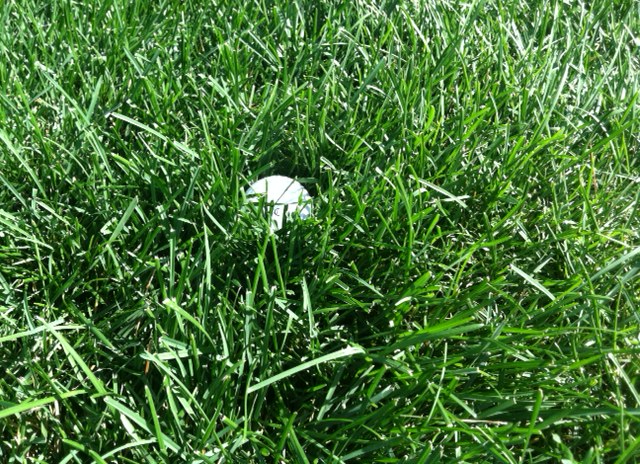
As you may have noticed ever since Jamie Farr wandered off the golf course that the rough has been a wee bit stout of late.  The Farr week rain combined with lovely growing conditions have turned our rough into a lush "cabbage patch".
Best rough we've had all season!!
While it is nice to finally see some green, healthy rough after such a dry, hot summer, it is unfortunate that it came so quick!  As you may have noticed with your own home lawn, it is incredibly tough to keep up with this accelerated growth rate. 

Fortunately, this flush should subside with the shorter days and cooler temps as hopefully the turf will decide to start growing some roots instead of lush topgrowth.  Bear with us as we continue to battle.  There may be some clumps in the rough for awhile, but soon we should be back on top of things. 

Finally, we will also be tackling the remainder of the cleanup post Jamie Farr.  Crosswalks are being punched, and when time allows, we will be out with some sod to repair as much remaining scarring from the summer as we can afford.  #7, #4, #3 among others need some sod especially in the step cuts around greens where poa "gave up the ghost" so to speak.

Wednesday, August 8

2012 Jamie Farr is upon us.

I realize that the Jamie Farr has begun, and I hope you will forgive me for not blogging much.  Taking a year off from hosting the event seems to have made things a little more labor intensive this year.  A few new subcontractors to train, new tournament officials, and continuing to recover from the hottest month in recorded history have all kept us really busy here.  Yes, it's finally official, July 2012 was the hottest month EVER!!  Especially in the midwest and plains states.  Check out the article below.

http://www.washingtonpost.com/blogs/capital-weather-gang/post/us-has-hottest-month-on-record-in-july-2012-noaa-says/2012/08/08/0fae675c-e169-11e1-98e7-89d659f9c106_blog.html

So far, the course is holding up ok to the early week Jamie Farr traffic.  The one upside to the drought conditions is that our rough is very firm.  The vast amounts of truck, car, and cart traffic has had little negative effect on these areas since they were already baked.  This is probably the first time ever the Jamie Farr traffic and structures actually made the course greener.

The Monday double Pro-Am was a little hard on some of our weaker greens like 3 and 4.  I was trying to figure out why, but in what can be best described as a "DUH" moment, I started counting the amount of people walking on the greens.  Through two full-field shotgun starts, we had 5-somes who each had caddies.  All together, it added up to roughly 400 or so people walking around the golf hole!  The pins remained in those positions for Tuesday practice, adding even more traffic.  Put 400 people in your crappy lawn and see how it looks after 8 hours.  We will nurse these greens as we do normally in hopes of quick recovery. 

Many members have commented on how green and great the fairways look.  "What are you doing special for the Farr?" they like to ask.  The answer is "We don't drive any friggin golf carts on them!"  The lack of cart tracks makes a huge difference in not only the health of the turf, but the general aesthetics and consistent color.  This is one of the major differences between our club and places like Inverness where carts are not allowed except in special circumstances.

Finally,with the exception of some chances of thunderstorms, the forecast looks good.  Milder temperatures are headed our way and should allow for minimal stress to the golf course.  The biggest stress is feeling like a parent letting his teenager throw a HUGE party on the lawn with 70,000 of his closest friends.

Wednesday, July 25

Getting the greens back on track

Without question, the most frequent comment from members during the last couple of weeks was in regards to the amount of grass that appears on the greens surface.  Overall, players weren't necessarily unhappy with the roll or speed, just that they looked "shaggy".  Well, I'm here to tell you, you are right!  And trust me, it's a good thing.

With the drought stress, heat stress, traffic stress, and long days we have experienced during the last three weeks or so, we have implemented practices designed to maximize the health of the greens.  As I've commented numerous times, when you are growing grass at 1/8th of an inch (especially if it's Poa), it doesn't hold up well in extreme weather conditions.  To "nurse" the greens through the hottest, driest, most stressful period on record, it was necessary to "back off" our usual regimen of practices and suffer less than our desired green speed.  It also didn't help that the hot weather really makes what bentgrass (not Poa) we have on the greens grow like gangbusters.  Ultimately, the thriving bentgrass has been noticably encroaching into the weakened Poa which is great.  Anytime we can increase the population of bentgrass on the surface it is a really good thing.

Now, with the immediate forecast looking a lot closer to "normal" (whatever that is now), days beginning to shorten, and we get closer to September, we can get back to carefully working on providing a higher quality putting surface and "push" the greens just a little.  Perhaps more of a "nudge" than a push, but we want them faster just as much as you do.

Yesterday, we put the grooved rollers back on the greensmowers, and tomorrow, will be very slightly decreasing our height of cut gradually down to our normal daily height.  We will add a double cut or two into the rotation along with rolling after we mow 3-5 times per week depending, of course, on whether or not the greens decide to "push back".  Should the greens remain healthy, we may do a very light "groom" with the vertical groomers on our greensmowers.  This will stand the turf up, "groom" the canopy and provide a smoother, quicker surface.

Now keep in mind, it is still July and the potential for more stressful weather is quite high.  We are by no means out of the woods yet.  Should the greens begin to suffer, we will be augmenting practices as necessary to protect our greens.  September will bring ideal conditions.  In the meantime, we are trying to give you the best performing surfaces we can.

Now I realize the timing is a little suspicious, what with the Jamie Farr starting in little more than a week, but I assure you I am NOT doing this for them.  I would be doing this regardless for our members and guests.  Now cross your fingers and hope for good grass-growing weather.  

Tuesday, July 24

Skip It!

I ran across this article from the USGA this morning regarding mowing and rolling practices and stressful summer weather.  It outlines a practice we have used quite often this summer during the record temperatures. 

Managing greens that are predominantly Poa annua makes for a difficult task when the weather is as hot and traffic is as high as this year.  We are doing our best to create acceptable conditions without jeapordizing the long-term health of the putting surfaces.

Check out the article below.


http://www.usga.org/course_care/regional_updates/regional_reports/northcentral/Skip-It---July-2012/

Wednesday, July 11

Catch-up

There has been much to talk about on the maintenance side of the club over the last couple of weeks.  Record heat, storms, fence, have all added up to a lot of busy bees down here.  While spending my time nursing the course through the last couple of weeks, I haven't had much time to blog, so I will try to play catch-up.

As you all know, the storms that rumbled quickly through our area late last week left a lovely mess.  #5 green was the victim of a large oak tree as was #16 tee.  We have been hard at work to repair and patch that green to get it in the most playable shape possible for the remainder of the summer season.  With such a large impact, there were "dimples" in the green up to 6 inches deep as well as one large limb that poked a hole 3 feet deep into the green profile.  We will continue to patch, roll, and sand the affected portion of the green to get it smooth.  It will take time, but eventually I expect a good recovery.

This oak was about 80 or so feet tall and alive.
Just what you want to see in your green!


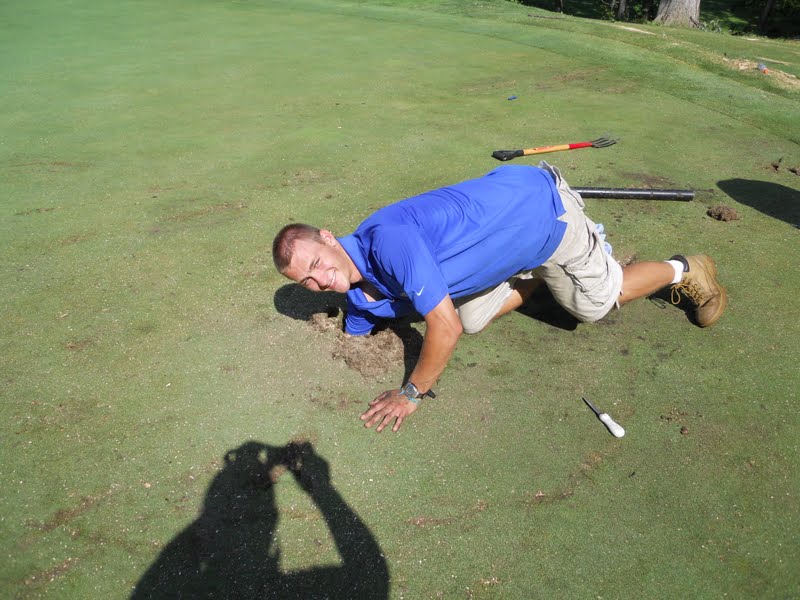
Jeff couldn't reach the bottom of the hole the limb poked into the green

Some of the more superficial damage.

Tools of the trade - oyster knife, steel pipe, and a pitchfork did a good bit of the surface lifting.  Hex plugs and cups did most of the rest

One of the other aspects of the storm is that it dropped around a half-inch of rain in about 10 minutes.  While this didn't seem like much, it did more harm than good.  Most of it puddled and collected in lower areas of the fairways.  The extra water in the soil combined with cart traffic and the next three days of 100+ degree heat basically "cooked" the Poa annua roots in those spots.  This has resulted in some "burnt out" areas in the fairways mostly in high-cart-traffic and drain areas where the water collected.  "Burnt out" is not really appropriate since these areas did not suffer from dryness at all!!! This is a great example of traffic stress, extreme heat, drainage issues, Poa annua, and soil type can all combine to cause serious turf health problems.   Many people think these areas have "checked out" due to the drought conditions this summer when the opposite is true.  Too much water and traffic had weakened these areas to where they couldn't survive the record heat we have had.  You will also notice that the majority of these areas are where cart traffic tends to be quite "funnelled". 

3 fairway in front of the ladies tee where so many carts tend to drive.

These areas are unsightly, but in this example there is some bentgrass surrounding that will hopefully take over.

#1 approach on the right.  The exact point where most carts drive despite our signs and ropes.  A curious note on this picture is the green "lines" of turf that did survive in our verticut channels (that's why we do it!!!).  The patches that survived are either bentgrass or ryegrass.

Another cart traffic/shade area on the approach to #3 green.  The ryegrass in the step cut and bentgrass survived well while the Poa annua is either dormant or severely stunted.  It is important to note these areas were never dry during the heat wave.
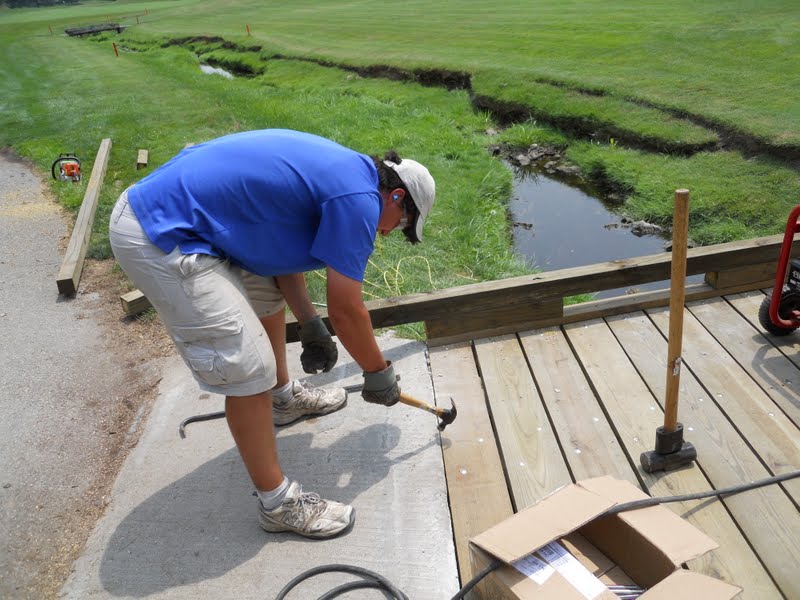
Finally, the other project you may have noticed is the cart bridge on #18.  As many of you noticed, the bridge deck had become quite wobbly and unstable.  Years of floods combined with traffic and pure age had taken their toll on the wooden deck and required it be replaced.  We did the work in-house and used much sturdier treated lumber that should last for some time.  I'm pretty sure you could drive a Sherman tank across the thing now.  We are also trying to smooth out the uneven concrete approaches for a softer transition from wood to cart path.

We use a chainsaw to remove the end boards and then pop the deck straight off.

This wooden center beam was no longer supporting the center of the deck, thus the "flapping wings"effect when driving across.

Rot.  It happens.

The rusty beams were scraped and painted with rustproof primer and high-quality paint.

New deck boards being placed.

The thicker deck boards left us perfectly level with the northern concrete approach but a little below the southern approach.  A little concrete hacking and grinding was necessary.  We will rent another machine to soften further.

Getting the edge just right with a little "persuasion".
Update:  The fence on Erie St. is mostly complete.  Contractors will be back on-site to finish installing the service gate opening mechanism and the security fence down the hill within the next week or so.  The recent storm and heat wave have prevented us from seeding around the fence for the time being, but we will get something down here very shorty.  Bear with us as we try to get the golf course back together from all the recent trouble.

Tuesday, June 26

Busy Busy Busy......

As the summer heat and stress loom in the very near future (looks like 98 thursday - ugh) we are very busy dotting the I's and crossing the t's on a few projects.  For the next 6-8 weeks, the crew will set large projects aside and primarily focus on maintaining the golf course and keeping things alive during what already looks like another brutal summer. 

The largest of these projects would be the new aluminum fence.  Our contractor has done a great job installing, but we have had to do our part to correct some unfortunate highs and lows in the grade.  We have been filling, raking, and digging our way along the line so that the installer can get from one end to the other with minimal "humps and bumps".  There are several natural ups and downs that were unavoidable, but with the widening of Erie St. 10 years ago, there was some sloppy finish work we needed to correct.  With the installation almost complete, we will be seeding, hydro-mulching, and fertilizing the disturbed ground to get as much grass as possible to come back.  Keep in mind that our sprinklers don't reach the fence very well given the reach and the trees, and it will be all we can do to get a good stand of turf going during a hot summer.  We will do our best and re-seed in the fall if needed.

A fair amount of new soil was added to soften the slope from the sidewalk to the golf course.  Almost 50 tons!

It didn't help that there were vines and small trees growing through the fence.  The removal of the root mass left quite a few holes and uneven areas.

Also, you may have noticed some tree work going on this week.  With no outings this past Monday, I finally was able to get a tree crew out to do some pruning and cutting.  We had some "widowmakers" hanging from some tall trees on the course as well as some unsightly deadwood that needed removed for aesthetics as well as safety.  #5 green also had a large dead tree directly behind it that was in danger of falling on the putting surface that needed to be dropped.  Also, the locust tree next to the putting green was in desperate need of pruning to prevent interfering with the flagpole.  A side benefit will be increased sunlight exposure to the west side of the green.
The locust by the putting green was quite bushy with a lot of low-hanging limbs that shaded the west side.

Some low-hanging deadwood that was dropping debris on the green and just looked plain awful.


The tree all cleaned up and more symmetrical.

As you can see, we are a busy bunch.  Most project work will slow way down come July.  With summer stress upon us, we will need to focus on maintenance, hand-watering, and keeping our sprinkler system functioning well. 

Tuesday, June 12

A sight for sore eyes

After 30+ years as a blight on our beautiful property, the fence along Erie St. is finally being removed starting today.  For the last 8 seasons, I have driven past that thing every day with my head turned away from it to avoid the embarassment.  When I bring friends, family, or colleagues here to "show off" my club, it's hard for them to believe we are a healthy private club that hosts an LPGA event when they look at that nightmare (and the shape of the clubhouse too).   It makes me happy to see the club spending a little money to improve curb appeal on the fence as well as the clubhouse.

While I realize that spending this money was controversial to some who would like to see every available dime go to the course, I feel it was a very wise decision not only to replace the fence but also address some of the myriad issues with the clubhouse.  The best way to get money for the golf course is to get more members.  The best way to get more members is to make our facility shine.  We don't have the fanciest clubhouse or the biggest, but it will serve us well not to look like a complete dump.  Also, it enforces the perception that we are improving our facility despite the economy.  The city has asked us year after year if we were going to do something about that eyesore, and we are finally making an effort to beautify the community that provides the majority of our members and income.

Now, we won't have to look the other way.

All the posts were buried during the Erie St. Expansion.  Each one is being dug up to detatch the chain link.

The first rolls are hitting the ground.  Good riddance to bad rubbish.

A fall in the bike lane today would might warrant a tetanus shot